 Stay
Stay 

Trading Conditions
Products
Tools


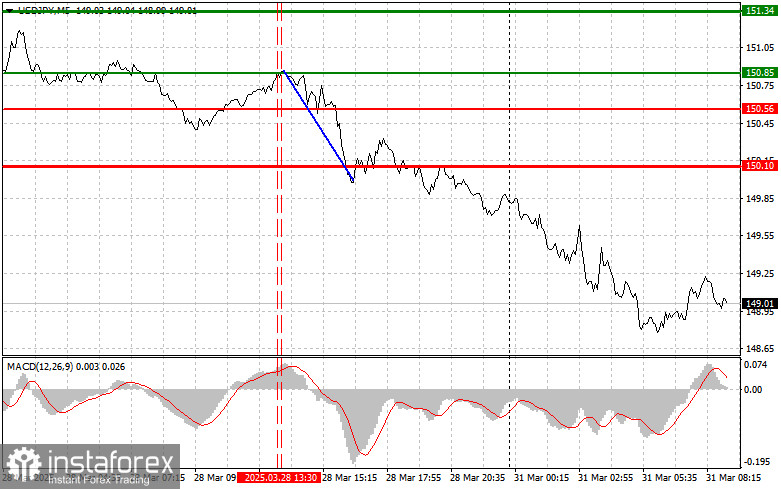
The price test at 150.85 occurred when the MACD indicator had already moved significantly above the zero level, limiting the pair's upside potential. For this reason, I did not buy the dollar. Shortly after, another test of 150.85 while the MACD was in the overbought zone triggered Sell Scenario #2, which led to a drop in the pair by more than 70 pips.
Today's strong data on Japan's industrial production growth supported the yen and put additional pressure on the dollar. Output increased by 2.5%, compared to the expected 1.9%. This unexpected rise signals a recovery of the Japanese economy following recent challenges. Increased production—especially in key sectors like the auto and electronics industries—brings optimism about Japan's economic outlook. The yen's appreciation against the dollar reflects growing investor confidence in the Japanese currency, which was traditionally seen as a safe haven during economic uncertainty. Additional pressure on the dollar also stems from expectations that the Bank of Japan might continue raising interest rates, especially given the improvement in economic indicators.
Japan's retail sales data also came out quite strong. Contrary to analysts' concerns of a decline, the indicator showed a confident rise, signaling a recovery in consumer demand. This is a positive sign for the Japanese economy, which has long struggled with deflation and weak growth. While it's too early to declare a full recovery, the positive retail momentum gives hope for further improvement.
For intraday strategy, I will focus primarily on implementing Scenarios #1 and #2.
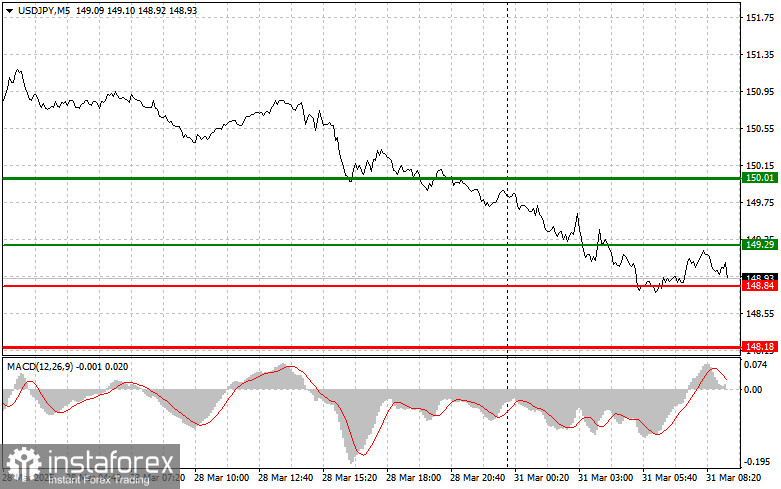
Scenario #1: I plan to buy USD/JPY today at the 149.29 entry point (green line on the chart), targeting a rise to 150.01 (thicker green line). Around 150.01, I plan to exit the long position and open a short position in the opposite direction (aiming for a 30–35 pip retracement). It's best to re-enter long positions after corrections and significant dips in USD/JPY. Important: Before buying, make sure the MACD indicator is above the zero level and just beginning to rise.
Scenario #2: I also plan to buy USD/JPY if the price tests 148.84 twice while the MACD is in the oversold zone. This would limit the pair's downside potential and lead to an upward reversal. A rise toward 149.29 and 150.01 can be expected.
Scenario #1: I plan to sell USD/JPY only after breaking below 148.84 (red line on the chart), which would lead to a quick decline. The main target for sellers will be 148.18, where I plan to exit the short position and open a long one (aiming for a 20–25 pip retracement). Selling pressure could return at any moment. Important: Before selling, ensure the MACD indicator is below zero and beginning to fall.
Scenario #2: I also plan to sell USD/JPY today if the price tests 149.29 twice while the MACD is in the overbought zone. This would limit the pair's upside potential and lead to a downward reversal. A decline toward 148.84 and 148.18 can be expected.
InstaForex analytical reviews will make you fully aware of market trends! Being an InstaForex client, you are provided with a large number of free services for efficient trading.


